

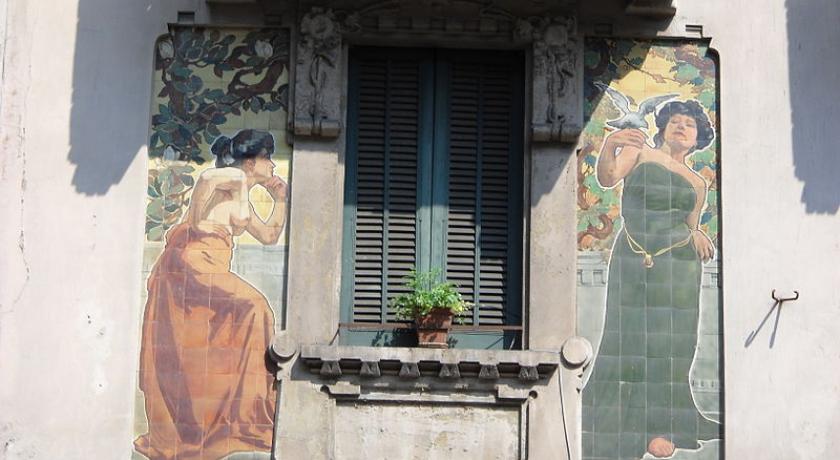


Description
Casa Galimberti is a building in Milan at 3, via Malpighi.
History of the building
Designed by the architect Giovanni Battista Bossi (1864-1924) in 1903-1905 for the Galimberti brothers, it is considered as one of the most brilliant examples of the Art Nouveau of Milan, thanks to the covering of the facade with tiles with ceramic images, wrought iron and cement floral motifs, all designed by Bossi.
In the same years, the Galimberti brothers built the Casa Campanini (1904-1906), one of the most representative buildings of the Art Nouveau of Milan, on a project of Campanini (1873-1926).
The building was built in part of the area occupied by the Limited Omnibus Company (SAO), founded in 1861 to manage public transport by tram in Milan, and which also had the concession for the Milano-Monza horse-pulled railway line, inaugurated on July 8th,1876 by Prince Umberto of Savoy.
In 1900 the Municipality decided to organize a competition for the service of electric trams, won by the Edison Company, the S.A.O. came second with Westinghouse technology. The Via Sirtori depot, which housed 280 horses, was closed, the land sold and the buildings demolished, with the exception of three stables of 54 horses, still visible on Via Sirtori, number 32 (Roland Berger Company) and 24 Nervesa Clothing Store).
They opened Via Malpighi and built new houses on the street.
The building was submitted to the protection of the Beaux-Arts in 1965.
Structure of the building
It has shops and public premises on the ground floor, and 4 apartments per floor in the other four floors.
It consists of two non-perpendicular parts at the corner of Via Malpighi with Via Sirtori, respectively 32 and 33 meters long.
Below the corner of the house is the Roggia (canal) Gerenzana, which carries the clean waters of the Martesana canal to Rogoredo to irrigate the agricultural land of the Brivio Sforza Counts. An open feature of 20 meters is visible in the courtyard of the building of via Spallanzani 10 (shop Unes). The canal gave water to the stables of the S.A.O.
The structure is composed of brick walls. The floor between the basement and the ground floor is made of reinforced concrete.
The base of the facade is in ceppo gentile of the cellar of Brembate e Trezzo, provided by Corda and Malvestiti Company from Vaprio d'Adda.
The first-floor guardrails are entirely made of cement, the second-floor guardrails have cement corners and a wrought iron central part, and the third-floor guardrails are entirely made of wrought iron.
Decorations
The rich ceramic decoration covers almost the whole facade on approximately 170 m2 and is made of ceramic fire-painted on drawings of Bossi.
The technique of fire-painting on ceramics consists of painting on the product already baked and varnished, and requires a subsequent firing of the tile.
The ceramics are the work of the Lombard Ceramic Society "Ing. A. Bertoni & C. "and the paintings were executed by Mr. Pinzauti for the ornamental part and Mr. Umberto Brambilla for the figures.
On the first floor are round female figures and on the other floors floral motifs.
The wrought iron decorations were made by the Society "Arcari and Bellomi" the seat of which is on the Corso Magenta 66.
Address
Milan
Italy
Lat: 45.474624634 - Lng: 9.207087517