

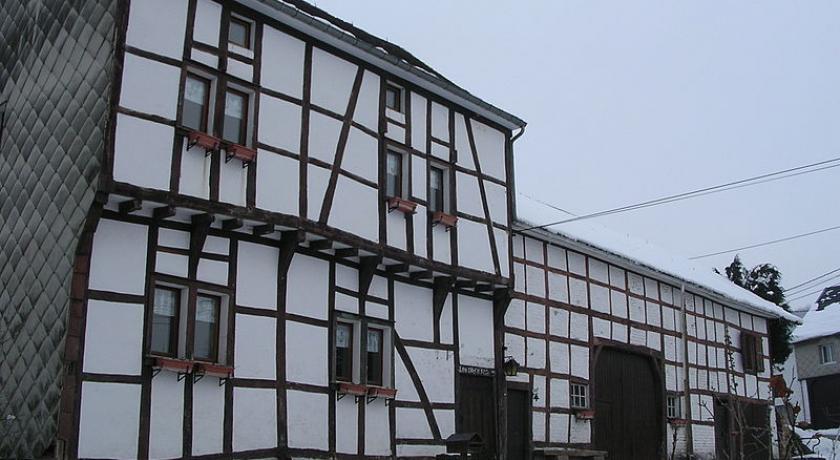


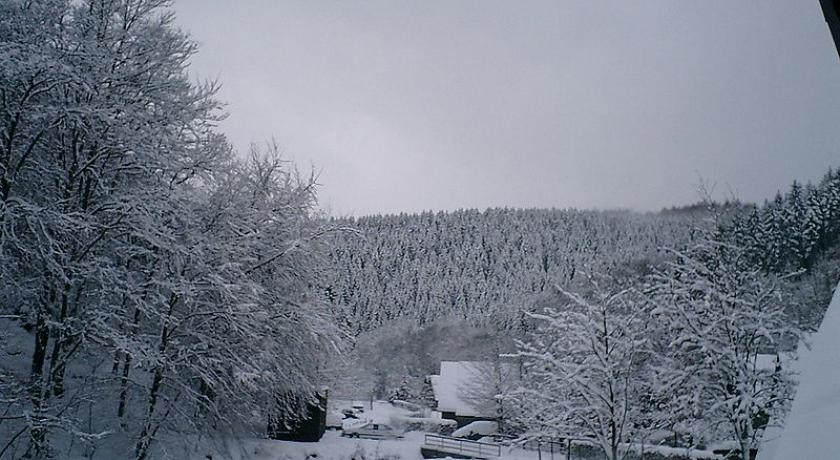

Description
Malmedy; German obsolete Malmünd) is a Walloon city and municipality of Belgium. It lies in the province of Liège. On January 1, 2006, Malmedy had a total population of 11,829. The total area is 99.96 km² which gives a population density of 118 inhabitants per km².
The municipality consists of the following sub-municipalities: Malmedy proper, Bellevaux-Ligneuville, and Bévercé.
Under the complex administrative structures of Belgium, which has separate structures for territorial administration and for language community rights, Malmedy is part of Wallonia and of the French Community of Belgium. But since it has a German speaking minority, it is one of Belgium's municipalities with language facilities (or "municipalities with facilities"). Malmedy and Waimes are the two Walloon municipalities with facilities for German speakers. The population of Malmedy is approximately 95% French speakers and 5% German speakers. The variety of German spoken is Moselle Franconian.
History
The name of “Malmedy” comes from the Latin sentence “A malo mundarum,” meaning “purifying from evil”. The name originated due to regular flooding in the past from the Warche River, which passes through the town.
The city was created in 648 by Saint Remacle, Provost of Solignac abbey in France. He had established his Benedictine Monastery in Malmedy. Between this date and 1794, the history of Malmedy is linked to the religious Principality of Stavelot-Malmedy, a clerical microstate.
For 1146 years, Malmedy and Stavelot formed together the Principality of Stavelot-Malmedy. 77 successive prince abbots of the Germanic Holy Roman Empire and the County of Logne led the state. However, a rivalry grew up rapidly between the two towns, because Saint Remacle decided to choose Stavelot as the main city of the Principality.
In the 16th Century a lot of industries appeared in the area of Malmedy: cloth industry, leather industry and the production of gunpowder. In the 17th Century, Malmedy and Stavelot became the most important tannery center in Europe. But the main industry in Malmedy was the paper making industry. It brought considerable wealth to the town.
In 1795, during the French revolution and the Liège revolution, the Principality of Stavelot-Malmedy disappeared and was united with France. Malmedy was a lower prefecture in the "département de l'Ourthe".
After the defeat of Napoléon in 1815, during the Congress of Vienna, the decision was made Malmedy, a roman and walloon town, would be linked to Prussia, a Germanic state. This special situation of Malmedy caused a lot of problems in the first fifty years. The inhabitants were free to speak French as they pleased, including its use in proceedings and decisions of the town council.
This situation changed when Chancellor Bismarck took power and following the Franco-German War of 1870. For the Prussian Administration, Malmedy suffered a double disadvantage as it was both francophone and the majority of the inhabitants were catholic. From this moment, Malmedy was forced to be Germanized. In schools, lessons in French were banned and the German language was mandatory. The priests were not allowed to preach any longer in French.
During the First World War, the population of Malmedy fought in German uniforms. But when the defeat of Prussia was proclaimed, Malmedy and the other eastern cantons were annexed to Belgium by virtue of the Treaty of Versailles.
Malmedy and neighbouring Eupen were subject to a plebiscite to determine whether the region would be separated from Germany and annexed to Belgium. The plebiscite ballots required registration of the names and addresses of the pro-German voters (the others were assumed to be pro-Belgian), and the German-speaking population of Eupen and Malmedy were intimidated. Both were formally annexed on 6 March 1925.
The main church of Malmedy was built in 1777 and served as a cathedral from 1920 to 1925. Some old sources spell the city's name "Malmédy" as this accent was intentionally added when being part of Prussia and Germany, but its official website lists it as "Malmedy", with no accent. Along with the neighboring city of Eupen, it formed a German-speaking area of Belgium. This was reversed after the war. During this period, a few undaunted individuals went as far as founding a “Walloon Club” in 1897, and this still exists today.
In 1944, during the Battle of the Bulge, the area was the site of the Malmedy massacre, where 84 American prisoners of war were executed by Nazi SS troops under the command of Joachim Peiper. This was one of a number of such massacres of prisoners and Belgian civilians which took place in the Malmedy area. Between 1940 and 1945, Malmedy was re-incorporated into Germany.
On 21 December the town itself, which was then held by US troops, was attacked by German forces under the command of Otto Skorzeny, who were repelled. Moreover, on 23, 24 and 25 December 1944 the city was bombed repeatedly by the United States Army Air Forces in a series of friendly fire incidents. Approximately 200 civilians were killed in the tragic attacks, while the number of American casualties has never been revealed by the United States Department of Defense.
Today, the people of Malmedy are a mix of Roman culture and German culture. Despite all the changes, the Malmedians seem to have preserved the qualities recognized by an 18th-century English chemist when he stated, “The inhabitants of Malmedy are honest, skillful, opulent, gracious, sociable and courteous towards foreigners.”
Tourism
Malmedy is famous for its historic monuments, museums, festivals, the Belgian grand prix, its beautiful scenery and its quaint villages.
Folklore
The locals are very proud of their national heritage the Walloon language and their folklore. The main festivals in Malmedy are the “Cwarmê” (Carnival), the “Saint-Jean d’été” (Midsummer's Day), the “Saint-Pierre” (the annual fun fair at Saint Peter's Day), the "Saint-Géréon" (in Walloon “Tribodlèdje”) and the Saint Martin's day (“Evêuyes”). There are also many smaller annual festivals in the local villages.
"Cwarmê" of Malmedy is a Walloon and Latin Carnival.
This important folklore event, which was first mentioned in old archive material from the XV century; the festival takes place from Shrove Friday to Shrove Tuesday, 40 days before Easter. For tourists, it's an opportunity to see the old traditional costumes in the "street carnival" and a parade. Some traditional costumes at the "Cwarmê" of Malmedy are:
The "Haguète" the most beautiful and the most famous traditional costume of the "Cwarmê". It has a large hat with multicolored feathers and uses a sort of long wooden tongs to catch the feet of a spectator.
The "Longuès-Brèsses" (Long-bras in French, Long-arms in English) is a kind of clown with long arms. He uses his arms to catch a spectator's hat and transfer it to somebody else’s head.
The "Long-Né". A group of 8 people who wear a long nose mask, a traditional blue smock and a long red-white cap. The “Long-Ne” chooses a spectator in the crowd then follows and imitates him until he agrees to offer them some beverages.
Attractions
Abbey of Stavelot
Between 1999 and 2002, the Abbey of Stavelot was completely renovated thanks to finance provided by the Walloon region. The cloister was rebuilt into the monastery building. On the old foundations, a new wing was built out of glass and stainless steel in the same proportions of the fourth wing destroyed during the French revolution. In the abbey grounds are the: Guillaume Apollinaire Museum, Museum of the Principality of Stavelot-Malmedy and the Spa-Francorchamps Racetrack Museum.
Museums
Next to the current abbey, recently excavated are the archaeological remains of the 11th Century abbey church, which have been made open to the public.
Malmundarium Museum
Next to the Cathedral the museum underwent major restorations, renovations and improvements, with the support of the Walloon Region, the French community and the city of Malmedy. Covering 3000 m2, the visitor can discover the past and the present of Malmedy and its region. This shows the leather tanning, beer and paper making history as well as the famous carnival, both world wars and much more. It only cost a few Euros and is very worth both the money and the time.
Address: Place du Chatelet, Malmedy, Belgium. Tel: 080 79 96 68
Museum Baugnez 44 Historical Center
Battle of the Bulge Museum
The Museum Baugnez 44 Historical Center traces the last major operations and battles that took place during the German offensive in 1944.
This museum opened in 2007, covering an area of 850 m2, spread over 2 levels, offers visitors an incredibly realistic view of the battle.
The Historical Center has an exceptional collection. A multilingual audio-guide provides comments and details of the battle, the history of the exhibits and various anecdotes of the time.
Vehicles, photos and period films are available. There are 15 scenes showing the daily lives of the soldiers. These scenes are equipped with a sound and light system to recreate the atmosphere of the time.
Address: Route de Luxembourg, 10, 4960 Malmedy. Tel: 080 440 482
Formula One Belgian Grand Prix
The Circuit de Spa-Francorchamps motor-racing circuit is the venue of the Formula One Belgian Grand Prix, and of the Spa 24 Hours and 1000 km Spa endurance races.
It is also home to the all Volkswagen club event, 25 Hours of Spa, run by the Uniroyal Fun Cup. It is one of the most challenging race tracks in the world, mainly due to its sharp corners and hills. Held the last week of August, which actually runs between Francorchamps, Malmedy and Stavelot (not Spa).
Belgian Brewery
Brasserie de Bellevaux
In the village of Bellevaux, located between Malmedy and Stavelot, you will find a Belgian brewery. Its original beers are brewed with the famous Ardennes spring water, in fabulous red copper vats. In the store are special beer glasses and a selection of the best products of the region.
You can enjoy trying this unique fresh beer in the comfortable tasting room or on terrace overlooking the brews and brewing vats also on offer are a few specialty dishes to accompany beer.
The High Fens
The High Fens, which were declared a nature reserve in 1957, are an upland area, a plateau region in the province of Liège, in the east of Belgium and adjoining parts of Germany, between the Ardennes and the Eifel highlands.
Lake Robertville
Lake Robertville is an artificial lake near the city of Malmedy in Belgium in Europe. The water volume is 8,000,000 m³ and the area is 0,62 km². The lake is located in the High Fens Park. The dam on the river Warche was built in 1928.
Local Villages
Chôdes, Boussire, G'Doûmont
Three small villages scattered among the hills and ridges along the road leading from Malmedy to Robertville, offer some splendid scenic views.
3 Wonderful walks, of which three are marked, depart from the Chapel.
Xhoffraix, Mont, Longfaye
You will discover the villages of Mont, Xhoffraix and Spa along the road connecting Malmedy to Eupen.
Bevercé
2.5 km from Malmedy, the charming village has a small chapel which dates back to 1723. Dedicated to Saint-Antoine a hermit, in its Tower contains the Bell of Gottfried Winckelmeyer of Collen.
The village of Bevercé has beautiful peaceful residential areas that have 4 hotels, a holiday centre, a hostel and 2 campsites.
The Hostellerie of the Chapel, has beautiful old stained glass windows of the old church of Xhoffraix. The freedom farm, a children's playground and a game park. Water tower at the foot of which offers a magnificent view over the Valley. Many sports activities are available in Bevercé: walks on foot or by V. T. T., fitness trail, communal outdoor swimming pool, fishing in the ponds of the campsite. There is a winding road that takes you through forests, streams and waterfalls to the plateau of Hautes Fagnes.
Burnister, Burnenville,
Perched 500 m above sea level, Bernister is a small peaceful village a super place for walking along the path that leads to the Hermitage of St - Antoine, which dates back to the 15th century.
The village of Burnenville is well known to fans of motor racing.
The Burnenville Chapel, built in 1755 is dedicated to Saint Hilaire. There is also a pond in the village built by the association 'Heritage Nature'.
Arimont, Géromont, Baugnez
These three charming villages are built along the road connecting Malmedy to the neighbouring commune of Waimes this beautiful setting attract many tourists to the bed & breakfasts, guest rooms and resorts. In the Warchenne Valley, is a hotel and holiday village offering various leisure activities and a campsite.
The little chapel Saint-Henri in Géromont
Cross Country trail skiing at Baugnez
The name of this last village is sadly associated with a war crime committed on December 17, 1944: a group of 84 GI prisoners were murdered in a meadow not far from the intersection where a monument to their memory is now: the American Memorial in Baugnez.
Bellevaux, Ligneuville
Ligneuville, extends to the bottom of the Valley of the Amblève, in an exceptionally pretty lush setting, surrounded by wooded hills.
The Amblève; this picturesque area is also the breeding ground for trout, it won the ‘Trout capital' award in 1984.
St. Donat chapel built in 1752 is part of the listed heritage of this commune. In this small village, you will also discover a fish farm, the House Micha, the grotto of the Virgin Mary in its beautiful park not far from the water of Recht.
In the charming village of Bellevaux with its picturesque hamlets is Bellevaux Church dedicated to Saint Aubin and is classified "Anno " 1435. Another building listed in the locality: the Maraite House which dates back to 1592.
You can also visit; the Old mill of Bellevaux dating back to 1387. The horticultural Greenhouses & gardens.
Mountaineering, exploring the rocks of the Warche.
Source https://en.wikipedia.org/wiki/Malmedy
Address
Malmedy
Belgium
Lat: 50.424640656 - Lng: 6.028327465