

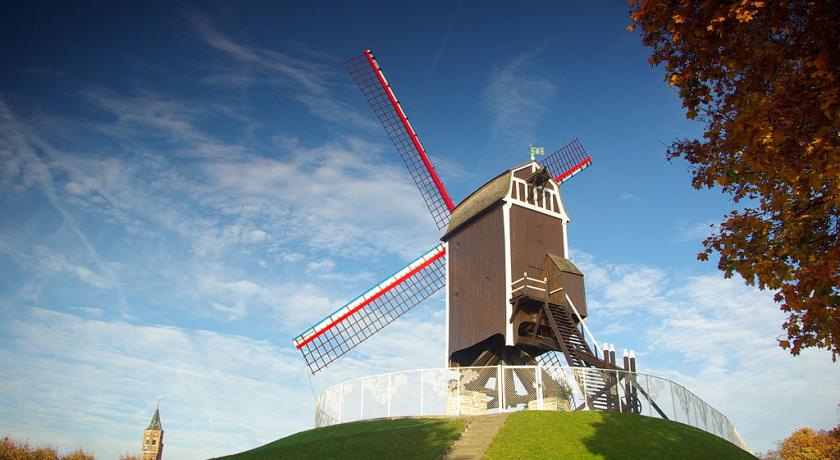


Description
Bruges; Dutch: Brugge is the capital and largest city of the province of West Flanders in the Flemish Region of Belgium, in the northwest of the country.
The area of the whole city amounts to more than 13,840 hectares, including 1,075 hectares off the coast, at Zeebrugge (from Brugge aan zee meaning "Bruges on Sea"). The historic city centre is a prominent World Heritage Site of UNESCO. It is oval-shaped and about 430 hectares in size. The city's total population is 117,900 (Year 2015) of whom around 20,000 live in the city centre. The metropolitan area, including the outer commuter zone, covers an area of 616 km2 (238 sq mi) and has a total of 255,844 inhabitants as of 1 January 2008.
Along with a few other canal-based northern cities, such as Amsterdam and Stockholm, it is sometimes referred to as The Venice of the North. Bruges has a significant economic importance thanks to its port and was once one of the chief commercial cities in the world. Bruges is well known as the seat of the College of Europe, an elite university institute for European studies regarded as "the EU's very own Oxbridge."
Origin of the name
The place is first mentioned in records as Bruggas, Brvggas, Brvccia in 840–875, then as Bruciam, Bruociam (in 892), Brutgis uico (toward end of the 9th century), in portu Bruggensi (c. 1010), Bruggis (1012), Bricge (1037, in the Anglo-Saxon Chronicle), Brugensis (1046), Brycge (1049–1052, again in the Anglo-Saxon Chronicle), Brugias (1072), Bruges (1080–1085), Bruggas (c. 1084), Brugis (1089), and Brugge (1116).
The name probably derives from the Old Dutch for "bridge": brugga. Also compare Middle Dutch brucge, brugge (or brugghe, brigghe, bregghe, brogghe), and modern Dutch bruggehoofd ("bridgehead") and brug ("bridge"). The form brugghe would be a southern Dutch variant. The Dutch word and the English "bridge" both derive from Proto-Germanic *brugjō-.
History
Origins
Bruges was a location of coastal settlement during prehistory. This Bronze Age and Iron Age settlement is unrelated to medieval city development. In the Bruges area, the first fortifications were built after Julius Caesar's conquest of the Menapii in the first century BC, to protect the coastal area against pirates. The Franks took over the whole region from the Gallo-Romans around the 4th century and administered it as the Pagus Flandrensis. The Viking incursions of the ninth century prompted Count Baldwin I of Flanders to reinforce the Roman fortifications; trade soon resumed with England and Scandinavia. Early medieval habitation starts in the 9th and 10th century on the Burgh terrain, probably with a fortified settlement and church
Golden age (12th to 15th centuries)
Bruges became important due to the tidal inlet that was important to local commerce. This inlet was then known as the "Golden Inlet" Bruges received its city charter on 27 July 1128, and new walls and canals were built. Since about 1050, gradual silting had caused the city to lose its direct access to the sea. A storm in 1134, however, re-established this access, through the creation of a natural channel at the Zwin. The new sea arm stretched all the way to Damme, a city that became the commercial outpost for Bruges.
Trade
Bruges had a strategic location at the crossroads of the northern Hanseatic League trade and the southern trade routes. Bruges was already included in the circuit of the Flemish and French cloth fairs at the beginning of the 13th century, but when the old system of fairs broke down the entrepreneurs of Bruges innovated. They developed, or borrowed from Italy, new forms of merchant capitalism, whereby several merchants would share the risks and profits and pool their knowledge of markets. They employed new forms of economic exchange, including bills of exchange (i.e. promissory notes) and letters of credit. The city eagerly welcomed foreign traders, most notably the Portuguese traders selling pepper and other spices.
With the reawakening of town life in the twelfth century, a wool market, a woollens weaving industry, and the market for cloth all profited from the shelter of city walls, where surpluses could be safely accumulated under the patronage of the counts of Flanders. The city's entrepreneurs reached out to make economic colonies of England and Scotland's wool-producing districts. English contacts brought Normandy grain and Gascon wines. Hanseatic ships filled the harbor, which had to be expanded beyond Damme to Sluys to accommodate the new cog-ships. In 1277, the first merchant fleet from Genoa appeared in the port of Bruges, first of the merchant colony that made Bruges the main link to the trade of the Mediterranean. This development opened not only the trade in spices from the Levant, but also advanced commercial and financial techniques and a flood of capital that soon took over the banking of Bruges. The Bourse opened in 1309 (most likely the first stock exchange in the world) and developed into the most sophisticated money market of the Low Countries in the 14th century. By the time Venetian galleys first appeared, in 1314, they were latecomers. Numerous foreign merchants were welcomed in Bruges, such as the Castilian wool merchants who first arrived in the 13th century. After the Castilian wool monopoly ended, the Basques, many hailing from Bilbao (Biscay), thrived as merchants (wool, iron commodities, etc.) and established their own commercial consulate in Bruges by the mid-15th century. The foreign merchants expanded the city's trading zones. They maintained separate communities governed by their own laws until the economic collapse after 1700.
Such wealth gave rise to social upheavals, which were for the most part harshly contained by the militia. In 1302, however, after the Bruges Matins (the nocturnal massacre of the French garrison in Bruges by the members of the local Flemish militia on 18 May 1302), the population joined forces with the Count of Flanders against the French, culminating in the victory at the Battle of the Golden Spurs, fought near Kortrijk on 11 July. The statue of Jan Breydeland Pieter de Coninck, the leaders of the uprising, can still be seen on the Big Market square. The city maintained a militia as a permanent paramilitary body. It gained flexibility and high prestige by close ties to a guild of organized militia, comprising professionals and specialized units. Militia men bought and maintained their own weapons and armour, according to their family status and wealth.
At the end of the 14th century, Bruges became one of the Four Members, along with Franc of Bruges, Ghent and Ypres, to form a parliament; however they frequently quarreled amongst themselves.
In the 15th century, Philip the Good, Duke of Burgundy, set up court in Bruges, as well as Brussels and Lille, attracting a number of artists, bankers, and other prominent personalities from all over Europe. The weavers and spinners of Bruges were thought to be the best in the world, and the population of Bruges grew to at least 125,000 and perhaps up to 200,000 inhabitants at this time around 1400 AD.
The new oil-painting techniques of the Flemish school gained world renown. The first book in English ever printed was published in Bruges by William Caxton. This is also when Edward IV and Richard III of England spent time in exile here.
Decline after 1500
Starting around 1500, the Zwin channel, (the Golden Inlet) which had given the city its prosperity, also started silting and the Golden Era had ended. The city soon fell behind Antwerp as the economic flagship of the Low Countries. During the 17th century, the lace industry took off, and various efforts to bring back the glorious past were made. During the 1650s, the city was the base for Charles II of England and his court in exile. The maritime infrastructure was modernized, and new connections with the sea were built, but without much success, as Antwerp became increasingly dominant. Bruges became impoverished and gradually faded in importance; its population dwindling from 200,000 to 50,000 by 1900.
The symbolist novelist George Rodenbach even made the sleepy city into a character in his novel Bruges-la-Morte, meaning "Bruges-the-dead", which was adapted into Erich Wolfgang Korngold's opera, Die tote Stadt (The Dead City).
Revival
In the last half of the 19th century, Bruges became one of the world's first tourist destinations attracting wealthy British and French tourists. By 1909 it had in operation an association called 'Bruges Forward: Society to Improve Tourism. After 1965 the original medieval city experienced a renaissance. Restorations of residential and commercial structures, historic monuments, and churches generated a surge in tourism and economic activity in the ancient downtown area. International tourism has boomed, and new efforts have resulted in Bruges being designated 'European Capital of Culture' in 2002. It attracts some 2 million tourists annually.
The port of Zeebrugge was built in 1907. The Germans used it for their U-boats in World War I. It was greatly expanded in the 1970s and early 1980s and has become one of Europe's most important and modern ports.
Geography
The municipality comprises
- The historic city centre of Bruges, Sint-Jozef and Sint-Pieters (I)
- Koolkerke (II)
- Sint-Andries (III)
- Sint-Michiels (IV)
- Assebroek (V)
- Sint-Kruis (VI)
- Dudzele (VII)
- Lissewege (with Zeebrugge and Zwankendamme) (VIII)
Get around
The historical center is not so big and thus pleasant for walking. The only mode of public transport inside city is bus. Buses are operated by the Flemish public transport company De Lijn. Taxis in the market place and station cost about €10. Bicycles are easy to rent and make getting around the city very speedy, although the cobblestoned paths can make the rides a little bumpy and uncomfortable.
Cycling in Bruges
Cycling in Bruges is the perfect way to discover the historical centre. Bruges citizens make fanatical use of their bikes. Up to 60% of all incoming traffic in the city centre is comprised of cyclists. Bruges can be described as a city where cycling is familiarized and where the local government puts a lot of effort into improving routes for cycling. According to Bruges, cycling is the main point of attention in all parts of infrastructure, city plans, permits etc. In 2012 Bruges received a nomination for ¨Belgium cycle city of the year¨. Also, for 15 years Bruges has been the starting point for the Tour of Flanders.
When you’re planning to visit Bruges you can easily hop on a bike and start to discover the city. There are various bike rental companies spread over the city and some of them also offer the opportunity to do a guided bike tour. A local guide will take you across Bruges highlights within a few hours. Two good bike tour companies are Baja Bikes and Quasimundo.
Attractions
Once over the encircling canal and inside the city walls, Bruges closes in around you with street after street of charming historic houses and a canal always nearby. In recent years, the city has turned so much towards tourism the locals sometimes complain they are living in Disney-land. The newly cleaned houses should however not confuse you; they are truly centuries old. And if you can get away from the chocolate-shops, you can visit some more quiet areas s.a. St. Anna, and imagine what life in the late middle ages must have been like.
The Bruges Card provides discounts to most of the major attractions (as well as to performances at the Concertgebouw , and can be picked up at any of the hostels around town. It is available for either 2 or 3 consecutive days. The reduced rate cannot be used in conjunction with a student rate (both student and Bruges card rates are identical) and hence is most useful for older travelers.
It is also possible to buy a combined ticket to see all Musea Brugge museums, which is good value if you intend to visit more than 2.
Several Youth Hostels (Bauhaus), and probably the train station and tourist information, offer a useful map with some very interesting, 'non-tourist' places to see during the day and some unique places to visit at night. It provides a good way of getting an authentic feel for the town whilst avoiding the tourist honey-pots and allows you to find some hidden gems.
Some highlights:
- Groeninge Museum, Dijver 12, B-8000. 7 days 9:30AM-5PM. Known as 'The city museum of Fine Arts', it houses a collection of artworks that span several centuries (14th-20th), focusing mainly on works by painters who lived and worked in Bruges. €8 / €6 (audio guide and ticket Arents House and Forum+ included in the entrance).
- Basilica of the Holy Blood (Heilige Bloed Basiliek), Burg 10. Apr-Sep 9:30AM-11:50AM & 2PM-5:50PM, Oct-Mar 10AM-11:50AM & 2PM-3:50PM. A beautiful church on the Burg square. It houses a relic - a vial of blood that is said to be that of Jesus - and was built in the Gothic style. Try and get there early so you can view the chapel when it is quiet and not filled with tourists. And don't forget to visit the chapel underneath, in heavy Romanesque style - a contrast to the lovely light Gothic above. Free.
- Brewery De Halve Maan, Walplein 26, Tel +31 50 332-697. Apr-Oct M-Sa 11:00-16:00, Su 11:00-17:00. This brewery annex beer museum offers a tour of the beer making process. A history of the brewery is provided, as well as an overview of the city from its tower. The tour lasts for 45 minutes and is a good way to get a feel for Belgian beer making. The tours start at the exact turn of the hour, be at least fifteen minutes early as there is a maximum amount of people that can join. The entrance price includes one drink of Brugse Zot or Straffe Hendrik and is served after the tour at the outside terrace or indoor bar. €7.00 including 1 beer.
- Onze Lieve Vrouwkerk, Mariastraat. A fascinating church with architecture from the Romanesque and Gothic periods. In the east end of the church are very fine tombs of Charles the Bold and his daughter Mary of Burgundy - in contrasting Gothic and Renaissance styles, despite their superficial similarity. The church also houses one of the few Michelangelo sculptures outside of Italy, the "Madonna with child". Currently 2 euro to see the Michelangelo.
- Jerusalem church. In a quiet area of the city, a highly unusual church with octagonal tower built by the Adornes brothers, merchants of Italian extraction. It includes a fine black tournai marble tomb, late Gothic stained glass, and a tiny and rather spooky chapel containing an effigy of the dead Christ. The entrance fee also covers the Lace Museum in the former Adornes mansion, where you can see local women and girls learning this traditional craft.
- The Begijnhof. Also known as the convent, between the centre of the city and the station, with white painted small houses and fine plane trees, is a quiet place to walk - groups are discouraged.
- The Hospital of St John. 09:30 - 17:00, Closed Mondays. Sint-Janshospitaal contains a museum of six paintings by Hans Memling, within the early medieval hospital buildings. €6 with Bruges card / €8.
- Choco-Story Museum, Wijnzakstraat 2 (Sint-Jansplein), Tel 050/61.22.37. 10AM-5PM. This museum, on several floors of a period house, describes chocolate's transition from cocoa into chocolate. It is run by the Belgian chocolate manufacturer Belcolade. Stay for the chocolate making exhibition to get some excellent samples. €6 with Bruges card / €7.
- DiamantMuseum, Katelijnestraat 43, Tel 050 33 63 26. 10:30AM-5:30PM. Diamond museum has a large range of exhibits ranging from mining all the way to polishing and all the history in between. Every day at 12:15 there is a live polishing demonstration. Individuals €6, Groups €4.5, Students €3.
- The Friet Museum, Vlamingstraat (opposite Academiestraat), Tel +32 50 34 01 50. 10AM-5PM. Check out the world's only frites (fries or chips) museum which tells the story of the humble potato from South America and how it has evolved into a fry. Don't forget to try the tastiest fries cooked by the guy who cooked for the Belgian Royal Family. 6 € : adult 5 € : group (from 15 people, reservation required) 5 € : students, 65+ 4 € : children from 6 to 11 years.
Bruges is visited by a huge number of tourists and it sometimes becomes quite annoying, especially around the Markt and Burg squares. The important thing to remember, however, is that very few tourists venture far away from the main shopping area, so if you want some peace and quiet you should simply explore the many small cobbled streets away from the main squares.
Lucifernum (retsin's lucifernum), Twijnstraat 6-8 (city center). An amazing (private) art gallery with Gothic cemetery in a subtropical garden located in the old Freemasons temple (1756 - 1882) 1000m2 art and mystery in Bruges' old city center. Open on Sundays from 18:00 till 21:00 entrance: 6 Euro
Things to do
- Grote Markt and Belfry Climb, Grote Markt (the big square). 09:30 - 17:00. Climb the 366 steps to the top of the 83-metre high tower. Excellent views of the city, Grote Markt and hear the bells ring up close. €6 with Bruges card / €8.
- Tour boats. It's essential to take a ride on one of the tour boats around the canals - the multilingual guides provide a potted history of the city in just a few minutes - at only a few Euros, it's the best introduction to Bruges. A boat tour will show you places which are otherwise unreachable, as not every canal runs next to a street. Advisable to get there at opening time to avoid the crowds. €7.60 plus almost obligatory tip to the driver/guide.
- Horse drawn carts, Grote Markt. Carriages can be hired for a romantic 30 minute trip around the old city of Bruges. Carts can carry up to 5 passengers. €39.
- Cycle. There are many rental shops near the main square, shop around for the best prices. You can also rent right at the train station and get to the city center quickly; remember to return them by 7:30pm. Cycle 5km to Damme, a picturesque village on the river with a windmill and excellent pancakes, and optionally follow on to the coast (another 15km). €8 for 4 hr at most places, €12 for the day.
- Snow and Ice sculpture festival, Station Bruges. Nov. 22 2013 - Jan. 05, 2014.. Every year from the end of November to January you can visit the Snow and Ice sculpture festival on the station-square of Bruges. The festival is built by an international team of 40 professional artists from no less than 300 tons of crystal clear ice and 400,000 kilos of fresh snow in a cooled hall where the temperature remains a constant -6°C. Don't forget to wear warm clothing! 11 - 15 EUR.
- Running. If you are a runner, try running the 7km circle around the old center. Walk along the canal and see all of the medieval gates that used to control the traffic in and out of Bruges. Simply stunning.
- Bruges Ballooning, Markt, Tel +32.475.972.887. AM & PM. Daily hot air balloon flights over the historic centre and its surroundings. The best way to enjoy the romance of Bruges — and its stunning views — from a few hundred meters up in a balloon basket. € 170. 00.
- Compare the real Bruges to the one depicted in the movie In Bruges.
- Concertgebouw Brugge, 't Zand 34. One of Bruges' culture temples with a world-class program in classical music and contemporary dance. The season usually runs from mid-September to June, but it also becomes a hub for the early music MA festival each August.
Shopping
Chocolate shops are plentiful and the standard is always high. A fairly cheap option is Stef's on Breidelstraat (between Markt and Burg). If you are willing to spend a little more, Chocolatier Van Oost on Wollestraat is a must for high-quality artisanal chocolate. Word on the street is that you can get anything covered in chocolate and molded. There is a large selection of chocolate shops at the Kathelijnestraat. There are also many boutique-style beer shops that sell high quality gift packs of Belgian beer.
For those who do not wish to buy chocolate in the chocolate shops, the local supermarkets also sell a good variety of mass-produced chocolate at fairly low prices. For the frugal, you can buy 100-200 gram gourmet bars of chocolate for about €1 each. Good brands to buy are Côte-d'Or and Jacques, both are Belgian. If you don't want anything more than a sampling of the most famous Belgian beers, supermarkets (not night shops) are probably your best choice. They even have gift packs with glasses.
There are plenty of arts and crafts shops too, with some excellent local artists. The lacework is risky: if everything sold was produced locally, the entire town would be working in the lace industry! There is a school for lace though, where you can still get "the real thing".
Most European tourists come for the weekend, so shops are open Tuesday through Sunday, but many shops and museums are closed on Mondays. Be sure to plan ahead.
- Dumon, Simon Stevinplein 11. Excellent, very high-end chocolate creations. They also make chocolate drinks.
Food
Restaurants are not always cheap or wonderful, although mussels and frites or fricadellen, frites with mayonnaise are outstanding here. Stay away from the central market place ("Grote Markt") and the Burg Square (e.g. the Tom Pouce Restaurant) when eating. Tourists are easy victims here. One tactic used by tourist traps is to present items (e.g. bread) as if they were free with your meal, then charge you exorbitantly for them. Even water may be charged at an exorbitant €6 for a small bottle.
You will, however, find great food if you wander off the beaten track. Find a street with more locals than tourists and ask somebody. The locals will be glad to help.
A lot of places do not open until 1800hrs.
- L'estaminet, at the Astrid Park. Good food, nice terrace, cool bartender. Try the renowned spaghetti for €8 or the delicious croque monsieur.
- La Romagna, Braambergstraat 8. Excellent family-run Italian restaurant and pizzeria. Inexpensive. Good menu for vegetarians.
- In't Nieuw Museum, Hooistraat 42, Tel 050331280. Belgian grill restaurant, well off the tourist track. Excellent steaks, reasonable prices.
- De Bottelier, Ezelstraat (close to Sint-Jacobsstraat). A favorite restaurant of many of Bruges' residents. Very reasonable prices and excellent food. Closed Sunday and Monday nights.
- Marieke van Brugghe, Mariastraat 17, Tel 050/34.33.60 (marieke@pandora.be). Small but good restaurant that attracts the locals. Fixed menu for €19
- Tom's Diner, West Gistelhof 23. Fantastic upscale take on satisfying, home cooked food. Prices are reasonable, as well.
- Kok au Vin, Ezelstraat 19/21. The Kok au Vin was memorable (both the entre AND the restaurant); the prices are reasonable for the high quality. Family owned and run. Reservations recommended.
- Restaurant Aneth With only 7 tables, we like to keep it small and cosy, with a personal touch.
- Brasserie Medard, Sint-Amandsstraat 18. Huge deal for low budget just near the centre: a mountain of (tasty) spaghetti with tomato sauce, cheese, and mushrooms for 3 EUR. Two options on the menu: vegetarian, non-vegetarian - both at the same price. Double its size for just €2 extra. Unbeatable. Very cheap beer too (kriek at 1,50 EUR). Most tables order the spaghetti. Tourists aren't welcome until they sit - be sure to sit down and impose your presence to be served. Be warned that if you wait to be seated, you are likely to be sent away for no reason. Bring your own musical instruments.
- t' Gulden Vlies, Mallebergplaats 17, Tel 050-334709. 7PM-3AM. An excellent night restaurant. Small romantic restaurant east of the Burg with excellent food and reasonable prices. Menus from 16 €.
- Cambrinus, Philipstockstraat 19 (near the market place), Tel +32 50 332-328. 11:00-23:00 daily. This is a very popular place, and for a reason. They have some of the best selection of Belgian beers, more than 440 in total. Some beers have really odd names like Satan, Lucifer, Nostradamus, or the Brunette. It's primarily a restaurant though, as all their hearty food is prepared with a special kind of beer. It's really delicious. Mains go for €17-19, but they also have the €26 prix fixe "Menu van de Brouwer", which features several Trappist beers. Make a reservation in advance, or else they might not have any seats available. €25-30.
- Le Pain Quotidien, 21 Philipstockstraat. A sandwich chain founded in Brussels but now found in the U.S., France and a number of other countries. Most of the food is organic, and the sandwiches (in particular the Tartine Bouef Basilic) are delicious. Somewhat expensive.
- Maximiliaan van Oostenrijk, Wijngaardplein 16-17, Tel +32 0(50) 33 47 23. Midrange restaurant offering plenty to eat including oysters and meat cooked several ways, plus of course frites. There is not much for vegetarians.
- Grand Cafe Passage, Dweersstraat 26, Tel +32 (0)50 340232. Attached to the Passage hotel/hostel is the atmospheric Grand Cafe, serving traditional Belgian cuisine and beers. Prices are slightly lower than the tourist traps and well worth it. Try the beef stew (very tender) or the ribs.
- Trattoria Trium, Academiestraat 27, Tel 050333060. This is a great spot to have a nice dish of pasta or pizza and is fully Italian. They also sell olive oil, pasta sauces and other authentic products. The decor has a warm home feeling. Try out their antipasto and the excellent house wine. € 15 - € 20.
- Bittersweet, St Amandstraat 27 (close to the Grote Markt and Belfry), Tel 050 34 87 69. Tu-Sa 9-6:30. 'Cosy and Delicious' just like it says. Great for breakfast and indulgent afternoon teas. Reasonable prices, better quality and friendlier service than the tourist traps on the Markt, its well worth the short walk down this quaint side street. Also serves the best coffee in the city!
- Den Gouden Harynck, Groeninge 25, Tel 050337637. Gastronomic restaurant which offers three course meals at very reasonable prices.
- Ribs 'n Beer, Ezelstraat 50, Tel 050707677. Offers unlimited spare-ribs in several varieties, amongst others one in a beer-chocolate sauce. Several other meat dishes as well, huge portions. It may be wise to make a reservation beforehand. €15-€25.
- De Vuyst, Simon Stevinplein 15, Tel 050342231. Bistro with a very charming interior.
- Laurenzino, Noordzandstraat 1, Tel +32 50 333-213. Su-Th 11:00-20:00, F 11:00-22:00, Sa 10:00-22:00. This is a good place to try out freshly baked Belgian waffles. They have them with chocolate, caramel, whipped cream or basically anything you want on top of it. They also have traditionally prepared ice cream available. It's easy to find, as you can smell the flavor of the waffles around the shop. €2.
- Chocolaterie Spegelaere, Ezelstraat 92, Tel 050/336052. Bruges Best Kept Secret, a place for chocolate-lovers.
- The 57, Wollestraat 29a, Tel +32 50336242. 11:30 - 22:00. The 57 is a romantic restaurant in Bruges
Drink
- De Garre, 1, De Garre, Tel 32 50 34 10 29. Hidden in a backyard, this pub offers a nice atmosphere and about 100 different kinds of beer, including home-brewed ones. The house beer is called 'Triple de Garre' and is 11% strong, a good way to start the night.
- 't Brugs Beertje, Kemelstraat. This excellent pub (recommended in the CAMRA guide to the Benelux region) has hundreds of different beers and an authentic beer-cafe atmosphere. Clientele is majority tourists. The front bar is crowded; what looks like the door through to the restrooms opens on another bar area. In 2005 it was closed for most of July - this might be an annual occurrence.
- Curiosa, (just off the main square). A good place for a lunch as well as a beer.
- Herberg Vlissinghe (Cafe Vlissinghe), Blekerstrat 2 (on the way to the Jerusalem church), Tel 050 34 37 37. Closed Mondays and Tuesdays. One of the less touristy bars, with a nice selection of draught and bottled beers. It's probably the oldest pub in Bruges dating from 1515. Rated 4.5 stars out of 5 on Trip Advisor based on 24 reviews.
- The area just north of the performing arts center has various cafes, most with sufficient beer selections, such as Cafe Leffe.
- The Druid's Cellar, St Amandsstraat 11/b, Tel 050614144. A very nice cozy place to drink a beer and listen to some good music. The bar is located underground and actually gives the impression of a cellar. Usually plays rock music. The bar has a wide selection of drinks, from simple beer to 16 year old Bushmills whiskey.
- Bean around the World, Genthof 5, Tel 050703572. American coffee house in the center of Bruges - offers free American newspapers and WiFi to its customers
- 't oost, Oostmeers 88 (near the train station), Tel 050689623. 8AM-5PM. Breakfast- and lunch room. Homemade food. Free Wi-Fi for customers. €3.50-22.50.
- Délisa 'Délices & Saveurs', Jan van Eyckplein 7, Tel 0032 50 34 09 89. Just a short walk from the Markt, this place undoubtedly has some of the best coffee in Bruges. With a genuine espresso machine, the Conti, and a passion for good quality, the owner Sabine, is great for a chat and a good coffee for only €2.
- De Bierbistro, Oude Burg 14 (1 min from market), Tel 0470296006. Beautiful cellar from the 15th century. Nice place to have a drink or eat homemade dishes made with beer. The prices are very reasonable and the location is excellent if you want to experience some history of Bruges
Source https://en.wikipedia.org/wiki/Bruges - http://wikitravel.org/en/Bruges#See
Address
Bruges
Belgium
Lat: 51.209346771 - Lng: 3.224699497