



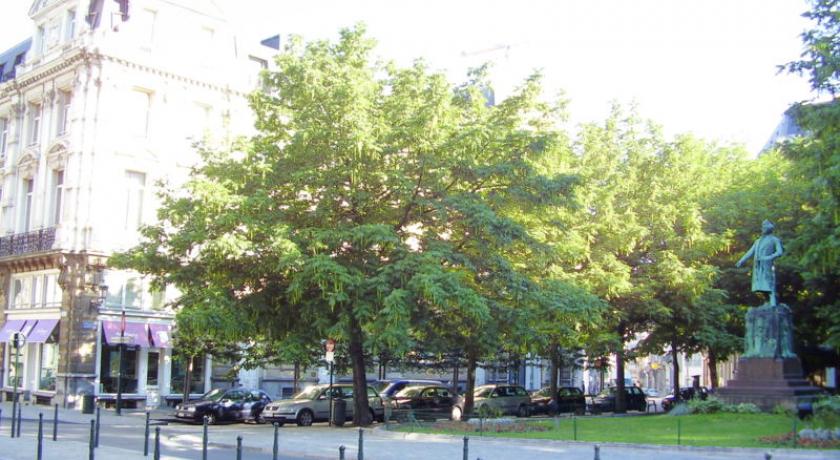
Description
Brussels (French: Bruxelles, Dutch: Brussel) is the capital city of Belgium and of Brussels Capital Region. It is entirely surrounded by Dutch-speaking Flanders and its constituent Flemish Brabant province. As headquarters of many European institutions, Brussels might also be considered something of a capital for the European Union. Being at the crossroads of cultures (the Germanic in the North and the Romance in the South) and playing an important role in Europe, Brussels fits the definition of the archetypal "melting pot", but still retains its own unique character. The population of the city of Brussels is 1 million and the population of Brussels metropolitan area is just over 2 million.
At first, the City of Brussels was simply defined, being the area within the second walls of Brussels, the modern-day small ring. As the city grew, the surrounding villages grew as well, eventually growing into a contiguous city, though the local governments retained control of their respective areas.
The construction of Avenue Louise was commissioned in 1847 as a monumental avenue bordered by chestnut trees that would allow easy access to the popular recreational area of the Bois de la Cambre. However, fierce resistance to the project was put up by the town of Ixelles (which was then still separate from Brussels) through whose land the avenue was supposed to run. After years of fruitless negotiations, Brussels finally annexed the narrow band of land needed for the avenue plus the Bois de la Cambre itself in 1864. That decision accounts for the unusual southeastern protrusion of the City of Brussels and for Ixelles being split in two separate parts. The Université Libre de Bruxelles' Solbosch campus is also part of the City of Brussels, partially accounting for the bulge in the southeast end.
Unlike most of the municipalities in Belgium, the ones located in the Brussels-Capital Region were not merged with others during mergers occurring in 1964, 1970, and 1975. However, a few neighbouring municipalities have been merged into the City of Brussels, including Haren, Laken and Neder-Over-Heembeek in 1921.These comprise the northern bulge in the municipality. To the south-east is also a strip of land along Avenue Louise that was annexed from the Ixelles municipality.
Language
Brussels operates as a bilingual city where both French (85%) and Dutch (Flemish) (15%) are official languages. Thus all the streets have two names, which can sound totally different. For example, the Main Square is called both la Grand Place and de Grote Markt. Although officially bilingual, French is undoubtedly Brussels' lingua franca. English is also widely understood, but not always widely spoken. Visitors should realize that language is a very divisive issue in Belgium (though this is not as noticeable in Brussels).
Historically Dutch-speaking, Brussels became more and more French-speaking during the 19th and 20th centuries. Today, most inhabitants speak French in daily life. Some numbers say that more than half of the inhabitants of Brussels do not speak French or Dutch at home. The Brussels dialect, a Brabantian dialect of Dutch, can be heard, especially in the outer districts of Brussels Capital Region. French speakers shouldn't have too much trouble understanding the local French. Dutch speakers may have some difficulty with the Belgian Dutch accent.
English has become a common spoken language because of the international institutions based in Brussels, such as the European Commission, the European Parliament and NATO. It is still relatively rare to find written tourist or general information in English, although the situation is improving greatly. One can expect public announcements in train stations to at least be said in French and Dutch, while larger train stations (such as Zuidstation/Gare Du Midi) typically include English and sometimes German. English is also used on metros, trams and buses, announced last for information such as line transfers and terminal stops. Do not hesitate to ask someone if you do not understand what has been said.
Climate
Brussels weather can often be grey and humid with a high and fairly evenly distributed annual average rainfall of 820 mm (32 in) and on average approximately 200 days of rainfall per year, both which are more than that of London and Paris. Summers tend to be cooler and wetter than London and winters colder. The daily and monthly temperature variations are quite small. Daily differences between average highs and average lows don't exceed 9ºC (16ºF).
In the summer, maximum temperatures rarely reach 30ºC (86ºF) but can feel much hotter due to high humidity. The summer visitor should be prepared for rain. Warm and sunny weather is not constant during that season or even to be expected.
After October, temperatures can drop off quite rapidly and winter months are often damp and chilly. However temperatures of 15ºC (59ºF) are not unusual into December. Snowfall is rare, and starts to melt fairly quickly, becoming slush on the ground. The winter visitor should be prepared for wet ground.
Boroughs and Attractions
Brussels is split into nineteen communes or gemeenten (municipalities/boroughs):
- Bruxelles/Brussel - Brussels encompasses many charming and beautiful attractions, with deeply ornate buildings on the Grand Place/Grote Markt, and a fish-and-crustacean overdose of St. Catherine's Square (Place St-Catherine/Sint-Katelijneplein). Stroll along, (and stop in for a drink) at one of the many bars on Place St-Géry/Sint-Goriksplein, or max out your credit card on the trendy Rue Antoine Dansaert/Antoine Dansaertstraat.
- Marolles/Marollen - A neighborhood of Brussels close to the city's heart, one of the few places where the Brussels dialect of Dutch (Flemish) could still be heard. The area is best known for the flea market held daily on the Place du Jeu de Balle/Vossenplein as well as a plethora of shops selling everything from old radios and bent wipers to fine china and expensive Art Nouveau trinkets. Visit on Saturdays or Sundays.
- Ixelles/Elsene - A vibrant part of town with a high concentration of restaurants, bars and other services to satisfy the good-looking or the heavy-spending. Some wandering around will reveal small bookshops, affordable ethnic restaurants or independent record shops tucked away in side streets. The Matongé district just off Chaussée d'Ixelles/Elsenesteenweg is the city's main African neighborhood. It is a large district in the South of Brussels spreading from newly gentrified immigrant neighborhoods off the Chaussée d'Ixelles/Elsenesteenweg near the town center to leafy suburbs close to the Bois de la Cambre/Ter Kamerenbos. The district is split in two by Avenue Louise/Louizalaan, which is technically part of the Bruxelles/Brussel district of the city.
- Molenbeek-Saint-Jean/Sint-Jans-Molenbeek - Commonly known as Molenbeek. A commune with a very large Moroccan and, lately, Romani (Gypsy) population.
- Saint-Gilles/Sint-Gillis - The city's bohemian epicenter with thriving French, Portuguese, Spanish, Maghrebi and Polish communities. The area around the Parvis de St-Gilles/St-Gillisvoorplein is the arty part, with the area around the Chatelain/Kastelein and the Church of the Holy Trinity being decidedly more yuppified. Like Schaarbeek, Saint-Gilles boasts several Art Nouveau and Haussmann-style buildings.
- St-Josse/Sint-Joost - The smallest and poorest commune not only of Brussels, but of all Belgium, this commune might not always be too pleasing on the eye but does have a few small, welcoming streets. The mid-part of the Chaussée de Louvain/Leuvensesteenweg is also home to a relatively small Indo-Pakistani community, so this is the place to head to for a tikka masala. The Turkish community which was the largest community only a few years ago has declined rapidly, as they moved to relatively wealthier communes by St-Josse/Sint-Joost standards.
- Uccle/Ukkel - Brussels' poshest commune. Green, bourgeois and starched like all posh communes should be. Uccle has retained many of its charming medieval cul-de-sacs, tiny squares and small townhouses as has nearby Watermael-Boitsfort/Watermaal-Bosvoorde.
- Woluwé-Saint-Pierre/Sint-Pieters-Woluwe and Woluwé-Saint-Lambert/Sint-Lambrechts-Woluwe are two communes at the eastern end of the city. Mainly residential, with a mixture of housing blocks, quaint neighborhoods and green areas this place is well-loved by Eurocrats and other professional types. The enormous Wolubilis cultural complex is well worth a visit.
Get around
On foot
Most sights in Brussels are fairly close together, within reasonable walking distance of each other. The oldest part of town can have uneven cobblestone roads, but the rest of the city is fairly easy to walk. Many roads in the old town are closed to cars. Brussels has many wet days, and in winter small amounts of snow can make the ground slushy, so water-resistant footwear is a must if you will be out walking all day.
By public transport
- STIB-MIVB, Tel +32 70 232 000 (0,30€/min). The Brussels region (Bilingual) public bus, tram and metro service.
The metro in Brussels is quite clean and safe compared to most metro systems. Metro entrances are marked by big "M" signs in blue and white, with the station name underneath. All announcements are made in Dutch, French and English. There are 4 metro lines (1, 2, 5 and 6) and 3 "chrono" (fast) tram lines (3, 4 and 7). Single tickets, called Jump 1 cost €2.10 if pre-purchased and are available from the driver for €2.50 (only trams and buses, not metro).
You validate the ticket in the small orange machines located in buses/trams, or at the entrance to metro stations/major tram stops. The orange machines time-stamp the ticket, both in ink and magnetically, and it will be valid for one hour. You can interrupt your ride and interchangeably use any STIB/MIVB transport. You should revalidate your ticket for each new ride.
One ride paper card tickets (called Jump 1) are available at all metro and bigger train stations. They can also be bought from vending machines near major bus and tram stops. There is also a 1 day pass (called Jump 1 jour/1 dag) available for €7.50. These tickets can be purchased either at staffed windows or from kiosks. However, the kiosks do not accept many credit and debit cards and will only accept cash payments in coins.
The five and ten ride tickets (Jump 5 and Jump 10 respectively) are no longer available as paper card tickets (they were withdrawn from sale on 1 July 2015, although existing part-used cards were still valid in October 2015). The Jump 5 and Jump 10 tickets must now be loaded onto a MOBIB or MOBIB-Basic smartcard.
Be aware that the 10 ride ticket can be used by more than one person. Example, if two of you are traveling together, you can just buy one 10 ride ticket, and when you enter the bus, or metro or tram, you validate the ticket twice by entering the ticket on the small orange machine two times. As soon as the ticket is spit out, you enter it again, and the machine will say 2 person, and there will be two lines on the ticket to indicate this. if you know you're going to use public transport a lot, getting the 10 fare pass might be cheaper than getting individual tickets.
Tickets that bear the name Jump are also valid on all SNCB/NMBS-trains and on buses run by Flemish public bus company De Lijn and Walloon public bus company TEC within the Brussels Capital Region.
By bike
- Brussels Bike Tours will take you on an easy (no hills) ride that lets you discover the city in just 4 hours.
Bicycle rental
- Villo runs a bike sharing network that has over 2,500 bicycles available at over 200 bike stations throughout the city. Users can take a bike from any station and return it to a different station. Membership fees are €1.60/day or €7.65 per week, payable by using a credit card with a smart chip at the automated kiosks attached to every station. On top of membership fees, usage fees vary, but the first 30 minutes are free. It is advisable to wear a helmet and a fluro vest (not mandatory). The bikes are robust, but rather heavy.
Attractions
A Brussels Card is available for discounts at many attractions. Available in 24 hr (€24), 48 hr (€36) and 72 hr (€43) versions, it offers a free guidebook, free entry to many museums, free use of public transit, and discounts at various shops, restaurants and attractions. May not be worth it to those who already receive discounts (children, students, etc). The card can be purchased on-line in advance for a discount, or at the tourist offices at: Grand-Place, Midi/Zui station, BIP. Some museums also sell the card.
Landmarks
- Grand Place-Grote Markt, . Surrounded by the city tower and a range of beautiful 300 year old buildings. In the evening, surrounded by bright illumination, it is simply ravishing. Some evenings a music and light show is provided with the buildings serving as a canvas. Have a "gaufre de Liège-Luikse wafel" here (Belgian waffle with caramelized sugar)—the best ones are available from the little shops off the northeast corner of the Grand Place-Grote Markt.
- Manneken Pis. Just a short walk from the Grand Place-Grote Markt is the Manneken Pis, a small bronze statue thought to represent the "irreverent spirit" of Brussels. This is a statue of a child urinating into a pool. Belgians have created hundreds of outfits for this statue. There are many stories of the statue's origins. It is believed to have been inspired by a child who, while in a tree, found a special way to drive away invading troops. Another story goes that a father was missing his child and made a declaration to the city that when he found him he would build a statue of him, doing whatever it was that he was doing. It has also been said a witch turned him to stone for peeing on her property. The most likely scenario is that it was the location of the market for urine, which was used for its ammonia content to tan leathers. None are definitively true. In 1747, Louis XV's soldiers stole the statue, upsetting many of the city's residents. Louis XV made it up to the city by giving the statue a medal of honor (so that he must be saluted when French soldiers pass by} and by giving him an outfit. He now gets dressed up on special occasions.
- Jeanneke Pis, Impasse de la Fidélité / Getrouwheidsgang, Brussels, Belgium.Jeanneke Pis is a modern fountain and statue in Brussels, which forms a counterpoint in gender terms to the city's trademark Manneken Pis at the Grand Place (Grote Markt). It was commissioned by Denis-Adrien Debouvrie in 1985 and erected in 1987 and endowed with its own instant legend, the better to amuse strollers. This half-metre-high statue of blue-grey limestone depicts a little girl with her hair in short pigtails, squatting and urinating, apparently very contentedly. It is located on the east side of the Impasse de la Fidélité / Getrouwheidsgang (Fidelity Alley), a narrow cul-de-sac some 30 metres long leading northwards off the restaurant-packed Rue des Bouchers / Beenhouwersstraat. It is unsurprisingly much less well known than its male counterpart, being a new addition instead of a centuries-old symbol of the city. The sculpture is now protected by iron bars from vandalism
- Parc du Cinquantenaire-Jubelpark - Definitely check out the Arc de Triomphe-Triomfboog on the east side of town. It's in the Parc du Cinquantenaire-Jubelpark. It is possible to go up to the terrasse above the arch, from where you'll have a good view of the city. Entry is through the Royal Museum of the Armed Forces and of Military History and is free. Take Metro line 1 east, exit Schuman and walk east or exit Mérode and walk west.
- Atomium, Square de l'Atomium/Atomiumplein (Take Metro line 6 direction Roi Baudouin-Koning Boudewijn and get off at Heysel-Heizel - approximately 5 min easy walk from the station), Tel +32 2 475 4777. Open daily from 10:00 AM till 6:00 PM. Ticket Sale ends at 5.30 PM. Unavoidable icon of Brussels and Belgium, important place for international tourism, unique creation in the history of architecture and emblematic vestige of the World Fair in Brussels (Expo 58) the Atomium continues to embody its ideas of the future and universality, half a century later. In its cultural program it carries on the debate of 1958: What kind of future do we want for tomorrow? Our happiness depends on what? Its recent renovation in 2006 gave its original brightness back, and the new equipment guarantees its durability. Five of the nine spheres are open to the public (so they say, but not really true). One of them is housing a permanent exhibition dedicated to Expo 58 (just some small models of some countries pavilions). Another sphere is dedicated to temporary exhibitions with scientific themes (often closed when there is no exhibition). The upper sphere offers spectacular views of the city of Brussels. When the sky is clear, the view reaches till Antwerp. There is a "kids zone" sphere which staff will happily direct you to even though you can never go in, it is only open to touring schoolchildren, and there is nothing inside except places for kids to sleep. In truth there are only three spheres: the top (restaurant), middle (snack bar) and bottom; the only thing to see really is the view; rather expensive at 11 €. The restaurant, also situated at the top, is open every day till 11.00 p.m. At night, the nine spheres are lit up with 2,970 lights that offer a very special show. To enrich your visit: audioguides in EN (but also in F, NL, ES, IT and RU) are available at the cash desk for 2€. Visio-guides are also available (€2) for the deaf and hard of hearing people. In August 2010, a zip-line was available from the top of the tallest sphere (102m); the "Death Ride" (run by former members of the Belgian Special Services) is a separate 25€, and offers a rather unique view of the insides of the Atomium and the surrounding city. Children of less than 6 years, coach drivers, disabled persons: free, children as from 6 years till 11 years: 2 €, adults: 11 €, teachers showing their teacher card: 9 €, children as from 12 till 18 years, students showing their student card and seniors (as from 65 years): 8 €.
- Palais de Justice/Justitiepaleis (Law Courts of Brussels), Place Poelaert/Poelaert Plein, Tel 02 508 64 10. 08:00-17:00 Mon-Fri. Larger than St. Peter's basilica in Rome, it cost 45 million Belgian Francs to construct in 1866. Free.
- Basiliek van het Heilig Hart / Basilique du Sacré Coeur (Basilica Koekelberg),Basiliekvoorplein/Parvis de la Basilique, Tel 02 421 16 60 (info@basilicakoekelberg.be). 9:00-18:00,. The fifth biggest church in the world, with an impressive interior and an amazing view over Brussels and its surroundings.
- Palais Royale/Koninklijk Paleis (Royal Palace), Place des Palais/Paleizenplein, Tel 02 551 20 20. 10:30-16:30. Royal Palace with a park out front. Free.
- The Bourse. Former stock market building. Locals like to sit on the steps, sometimes with fries. A local restaurant owner has proposed turning the unused building into a beer hall.
- Mini-Europe, Tel +32 2 478 0550. Hosts a set of scale models of famous European structures. €12.90 Adults; €9.70 under 12.
- Scientastic, (in the tram station Bourse/Beurs). 101 surprising and wonderful hands-on science exhibits. €7.90; children €5.30.
- Statue of Europe. Also referred to as Unity in Peace, this sculpture symbolises peace through European integration, while at the same time aiming to demonstrate the motto of the European Union (EU), United in Diversity. It is located in the garden of Convent Van Maerlant (the library of the European Commission) Van Maerlant street, in the European Quarter of Brussels.
- Red Light District. Just like Antwerp and Amsterdam, Brussels also has its own Red Light District. It is located mainly in Rue d'Aerschot/ Aarschotstraat, behind the North Train Station. Contrary to The Netherlands, prostitution is NOT legal in Belgium, they exploit a loophole in the local legislation presenting brothels as "bars". Do not expect to actually get a drink in there though. Despite heavy police presence, it still remains a fairly seedy area, not the kind of place where you'd want to walk alone at night.
Museums and Galleries
- Musées Royaux d'Art et d'Histoire (MRAH) - Koninklijke Musea voor Kunst en Geschiedenis (KMKG), Parc du Cinquantenaire-Jubelpark 10, Tel +32 2 741 7211. Open Tu-Fr 9.30AM-5PM, Sa-Su and holidays 10AM-5PM, closed Mo and various holidays, last entry 4PM. This museum has an important collection of art objects from different civilizations from all over the world. The museum was founded in 1835 and was located in the Hallepoort/Porte de Hal, one of the last remaining medieval city gates of Brussels. Adults €5.
- Musées Royaux des Beaux Arts de Belgique - Koninklijke Musea voor Schone Kunsten van België (Royal Museums of Fine Arts of Belgium), Rue de la Régence-Regentschapstraat 3, at Place Royale-Koningsplein, Tel +32 2 508 3211. Museum of Historical Art: Tues-Sun 10AM-noon and 1-5PM; Museum of Modern Art (Magritte Museum) Mar: Tue-Sun 10AM-1PM and 2-5PM. Features both historical art and modern art in the one building. In a vast museum of several buildings, this complex combines the Musée d'Art Ancien-Museum voor Oude Kunst and the Musée d'Art Moderne-Museum voor Moderne Kunst under one roof (connected by a passage). The collection shows off works, most of them Belgian, from the 14th to the 20th century, starting in the historical section, with Hans Memling's portraits from the late 15th century, which are marked by sharp lifelike details, works by Hiëronymus Bosch, and Lucas Cranach's Adam and Eve. You should particularly seek out the subsequent rooms featuring Pieter Brueghel, including his Adoration of the Magi. Don't miss his unusual Fall of the Rebel Angels, with grotesque faces and beasts. But don't fear, many of Brueghel's paintings, like those depicting Flemish village life, are of a less fiery nature. Later artists represented include Rubens, Van Dyck, Frans Hals, and Rembrandt. Next door, in a circular building connected to the main entrance, the modern art section has an emphasis on underground works - if only because the museum's eight floors are all below ground level. The collection includes works by van Gogh, Matisse, Dalí, Tanguy, Ernst, Chagall, Miró, and local boys Magritte, Delvaux, De Braekeleer and Permeke. Don't miss David's famous "Death of Marat." €8.00 adults per museum or €13 combo ticket, €2.50 students/seniors/disabled visitors, €1.25 children 12-18, under 12 free. Also free on the first Wednesday afternoon of every month.
- Musées d'Extrême-Orient - Musea van het Verre Oosten, Avenue Van Praetlaan 44 (Tram: 3 or 23 (Araucaria stop). Bus: 53, De Lijn 230, 231 et 232 (De Wand stop)), Tel+32 2 268 16 08. Tu-Fr 9.30AM-5.30PM, Sa-Su 10AM-5PM, closed Mo. Intriguing complex of three buildings in the Laaken area, not far from the Atomium. They comprise a Japanese tower, a Chinese pavilion, and a museum of Japanese art. The architecture and decor may seem over the top to today's tastes, but there are some outstanding examples of Chinese export porcelain, and rotating exhibitions of Japanese artefacts from the Edo period (1600-1868). €4 adults, €3 students, €1.50 children.
- Musée BELvue - BELvue Museum, Place des Palais-Paleizenplein 7, Tel +32 70 22 0492. Tuesday to Sunday, from 10:00 a.m. to 6:00 p.m. (June to September), from 10:00 a.m. to 5:00 p.m. (October to May). Features Belgium's history. Before it became a museum, the former 18th century luxury hotel was a royal residence. BELvue: €3, Coudenberg: €4, BELvue + Coudenberg: €5.
- Natural Sciences Museum of Belgium, Rue Vautier-Vautierstraat 29 (near Luxembourg station), Tel +32 2 627 4238. Open: daily from 9:30AM to 4:45PM; Saturday, Sunday and during school holidays (except the Summer break), from 10AM to 6PM; during the Summer break daily from 9:30AM to 4:45PM daily and in weekends from 10AM to 6PM. . The museum is well-known for its famous collection of iguanodons (dinosaurs discovered in a coal-mine in Belgium). The dinosaur collection has been refreshed in October 2007 and includes discovery activities for the children. The other parts of the museum are also interesting, as an exhibit of all animals that live in our houses and a collection of mammals. Price between €4.50 and €7, free the first Wednesday of each month as of 1PM.
- Horta Museum, Rue Américaine 25, Saint-Gilles/Amerikastraat 25, Sint-Gillis (tram 81, tram 92 (place Janson), bus 54), Tel +32 2 543 0490 (fax:+32 2 538 7631). Open daily 2PM-5:30PM, closed Monday. The home of noted Belgian Art Nouveau architect and designer Victor Horta. Seeing where he lived and worked is a great way to get an introduction to the art nouveau style in Brussels. It is one of four Horta works to be inscribed on the UNESCO World Heritage List. It can be very busy on rainy Sundays and the queue is outside, so don't forget your umbrella.Adults €7, students/seniors €3.50, guided tours available by appointment.
- Royal Museum for Central Africa (RMCA), Due to re-open mid 2017 Leuvensesteenweg 13, Tervuren (Take tram 44 through at Montgomery and get off at terminus after a 20 minutes enjoyable trip through woodland patches. The museum is a 300 m walk away), Tel +32 2 7695211 (fax: +32 2 7695242).Tue-Fri 10-17, Sat&Sun 10-18. The Museum is home to some truly remarkable collections. Its collection of ethnographic objects from Central Africa is in fact the only one of its kind in the world. It also contains the entire archives of Henry Morton Stanley which are of great historical value. The actual state of the museum makes it some kind of "museum in the museum" Apart the new (or newish) sections about the Congo River and the colonial period (with some ambiguous statements about the Belgian role), the structure of the museum seems to have been "frozen" 50 years ago. Casing, labels (largely almost nonexistent or vanished), (dis)organization of the collection in homogeneous topics, especially in the ethnographic section, reflect those of a museum conceived a century ago and never updated since. Labels, where available, are in Dutch and French only in the permanent exhibition. In fact, the museum will close from 1/12/2013 to mend these issues and will reopen after major renovations of buildings and exhibitions about mid 2017. The audio-guided farewell tour "Uncensored" (7 €, including permanent exhibition access) temporary exhibition (largely embedded inside the permanent exhibition tour) digs deep in the history of the museum. In some ways, it is a pity that in the future we will get a more enjoyable and interesting museum, but we will soon loose this unique remainder of the old age of museums.€4 adults, €1.50 young people (13-17), free for children under 12.
- Belgian Comic Strip Center (Centre Belge de la Bande Dessinée, Belgisch Centrum van het Beeldverhaal), Rue des Sables-Zandstraat 20, Tel+32 2 219 1980 (visit@comicscenter.net, fax: +32/2/219 23 76). Tue-Sun 10AM-6PM. Located in Europe's earliest Shopping-Mall (a shiny Jugendstil/Art Nouveau palace). There is a permanent exposition featuring the early beginning of comics as well as it's development. There is enough room for other varying expositions. The bookshop at the ground floor sells many different comics. A readers' library operates on the ground floor, where, for a low entrance fee, you can read many different comic books and buy fries. €7.50 adults, €6 students/seniors.
- Musée du Cinéma-Filmmuseum, Palais des Beaux-Arts-Paleis voor Schone Kunsten, 9 rue Baron Horta-Baron Hortastraat 9 (walk from Gare Centrale-Centraalstation), Tel +32 2 507 8370. A history of film-making. Free to look around; classic and cult films are shown at low prices.
- Autoworld, Parc du Cinquantenaire-Jubelpark 11 (Metro: Merode or Schuman Train Station (Line 1)/Train: Merode or Schuman Train Station/Bus: 20, 28, 36, 67, 80/Tram: 81), Tel +32 2 736 4165. 10:00 - 18:00 (4/1-9/30) 10:00-17:00 (10/1-3/31). Automobiles from the dawn of the motoring age to 1970's including the earliest Mercedes, Renault, BMW Isettas, Tatras, Ford T-birds, even a jeepney from the Philippines. Adults €6, children 7-13 €3, children 6 and under free.
- Musée Royal de l'Armée - Koninklijk Museum van het Leger en van de Militaire Geschiedenis (Belgian Army Museum and Museum of Military History), Parc du Cinquantenaire-Jubelpark 3 (Metro: Merode or Schuman Train Station (Line 1)/Train: Merode or Schuman Train Station/Bus: 20, 28, 36, 67, 80/Tram: 81), Tel +32 2 737 7809. 9:00 - 16:45. The Belgian Army Museum and Museum of Military History occupies the north wing of the Palais Cinquantenaire. It provides an overview of the development of military technology and of the major campaigns fought on Belgian soil. The museum has three principal sections: Belgian military history (documents, uniforms and weaponry from the Middle Ages to the present day, including a most comprehensive collection of medieval arms and armor); the Armored Vehicle Hall with artillery, tanks etc. from the two World Wars; and the Air Section (Brussels Air Museum) with a collection of aircraft from World War I onward. The Brussels Air Museum's high point is its collection of original aircraft from World War I. Free.
- Musical Instruments Museum (Musée des Instruments de Musique or Muziekinstrumentenmuseum), Montagne de la Cour-Hofberg 2, Tel +32 2.545.01.30,. Open Tu-Fr 9.30AM-16.45PM, Sa-Su 10AM-16.45PM. The museum houses more than 7000 instruments. The museum’s reputation is built on its extraordinary collection. The exhibits are displayed on four different floors featuring a wide range of instruments from all time periods and areas of the world. The MIM is a place to experience music. An infrared headphone system allows each visitor to enjoy the sound and melodies played by the instruments presented. The restaurant on the roof is also famous because of its panoramic view over Brussels. You need around 3 or 4 hours to really enjoy the whole museum, make sure you have enough time! The ornate façade of the building was decorated as such to promote the work of local tradesman and to protest the loss of jobs due to automation.Adults: €8; over 65: €6; under 26: €2.
- Musée Magritte Museum, 1 Place Royale-Koningsplein 1, Tel +32 2 508 32 11 (fax: +32 2 508 32 32). Tuesday to Sunday: from 10 a.m. to 5 p.m. Closed Mondays, January 1st, 2nd Thursday of January, May 1st, November 1st and 11th, December 25th. This museum is dedicated to the life and art of the Belgian artist René Magritte. It holds a multidisciplinary collection containing more than 200 of Magritte's works. Note that signs and labels are in French and Dutch only so English speakers should consider getting the audio guide. Standard rate: €8, Combi with Modern & Ancient Art Museum: €13, Students 18-25 years and school groups min. 12 pers.: €2. Audioguide: €4.
- Musée Juif de Belgique - Joods Museum van België, 21 Rue des Minimes-Miniemenstraat 21, Tel +32 2 512 19 63. Everyday except Mondays from 10 a.m. to 5 p.m.. Dedicated to the craft, folk art, culture and religion of the Jewish people in Belgium. Standard rate: €5, Concession 3€.
European Union
Brussels is considered to be the de facto capital of the European Union, having a long history of hosting the institutions of the European Union within its European Quarter. The EU has no official capital, and no plans to declare one, but Brussels hosts the official seats of the European Commission, Council of the European Union, European Council, as well as a second seat of the European Parliament.
- European Parliament, Rue Wiertz/Wiertzstraat 60 (European Quarter), Tel +32/2 284 21 11 (fax: +32/2 284 35 30). Mon-Thu at 10.00h and 15.00h; Fri at 10.00h only; Closed official holidays. Multimedia-guided tours in all official EU languages. Don't forget to bring an ID card/driver License with you. Free.
- European Commission, Rue Archimède/Archimesstraat 73. Guided tours not available. Presentations available for groups of 15 or more, booked in advance.
- European Council, Rue de la Loi / Wetstraat 175, Tel+32 2 281 2140 (fax: +32 2 281 6609). Guided tours not available. Presentations available for groups of 15 or more, booked in advance.
Breweries
- Cantillon Brewery, Rue Gheude - Gheudestraat 56, Tel 02 521.49.28. Monday to Friday from 8.30 AM till 5 PM; Saturday from 10 AM to 5 PM; Closed on Sundays and public holidays. The last traditional gueuze/lambic brewery in Brussels, Cantillon still uses natural yeast fermentation (not injected like almost every other beer). The lambics and gueuzes are made in original style with no sweeteners or syrups added. Only 100% bio (organic) and natural fruits are used creating a distinctly sour drink. This museum-esque atmosphere is still a functioning brewery. The tour includes two small glasses of lambic and gueuze, and if you've never had a natural beer before, then you will be (pleasantly) surprised by the taste. An absolute must for beer lovers, save room in your luggage to take bottles back with you! Tour with tasting € 6, tasting alone € 2.
- BrewSpot, Various places in Brussels, Tel 0479 56.47.23 (contact@brewspot.com). See the calendar on www.brewspot.com for the dates of the upcoming brewing events. Ever wanted to learn how to brew your own Belgian beer at home? This is your chance! BrewSpot offers a Discovery course where you will directly brew a Belgian style beer using malts, hops and yeast. This happens on afternoons (between 1pm and 5pm) in little groups of 10 to 15 people. During the course, you will also get to taste 5 different beers to show you the influence of the brewing ingredients on the final beer. You also get to take a few bottles of home-made beers and a booklet with useful brewing information back home! For those who want more, BrewSpot also offer a BrewMaster course where you get additional brewing theory during a consecutive second afternoon. For groups, BrewSpot can organise a special course for you on demand. BrewSpot is also in Paris by the way! For bookings, you need to send an email to contact@brewspot.com Discovery Course € 69, BrewMaster Course € 149, Incentives on demand.
Woluwé-Saint-Pierre is a commune in Brussels. It is mostly a well-to-do residential area, which includes the wide, park-lined, Tervuren Avenue (French: Avenue de Tervueren, Dutch: Tervurenlaan) and the numerous embassies located near the Montgomery Square (Square Montgomery, Montgomeryplein).
- Bibliotheca Wittockiana, Rue du Bemelstraat 21, Tel +32 2 770 5333. A museum that is dedicated to the art of binding books, with one of the most prestigious bookbinding collections in the world. Quite interesting. A discovery of forgotten discipline. Amazing use of materials, that unexpectedly gives room to innovation. Open from 10am to 5pm; closed on Mondays and official holidays. 8€ adults, 4€ students, groups and senior citizens. Free on the first Sunday of the month.
- Musée du Transport Urbain Bruxellois-Museum voor het Stedelijk Vervoer te Brussel (Transportation Museum of Brussels), 364 Avenue de Tervuren/Tervurenlaan (Take Metroline 1B (dir. Stockel). Step down at Metro M station Montgomery. There, take Tram 39 (dir. Ban Eik) or 44 (dir. Tervuren) from their terminus. Step down at 6th stop “Depot de Woluwe/Woluwe Remise”. Tram museum is just at your left.), Tel +32 2 515 3108. Open from 1.30pm to 7pm on Saturdays, Sundays and public holidays from the first weekend of April until the first weekend of October.Old trams are regularly used to link the museum to one of Brussels suburbs, Tervuren, through a very nice wooded area. The trip is especially pleasant on a sunny day. From the end station in Tervuren you can go to a nearby old train station that has been converted to a bar and small restaurant named Spoorloos (literally "without tracks"). €5 Adults, €2 Children age 6-11, under 6 free.
- Woluwe Park, Near Avenue de Tervuren (From center, take a tube (Stockel direction), step down at Montgomery station. Take tram 39 or 44. Step down at 4th station Chien vert. OR, by bus 36 if you take it at Schuman station area.).
- The imposing modern city hall is open to visitors.
- The town’s main church (Saint Peter) was erected in 1755 on the site of a much older building and perpendicular to it, with funds from the abbey of Forest. Traces of the older building can still be seen on the left of the current church.
- Several turn-of-the-century houses and manors can still be seen today, such as the Stoclet/Stokkel House, a UNESCO World Heritage Site, which was built between 1905 and 1909 on a design by Josef Hoffmann and contains mosaics and paintings by Gustav Klimt.
Things to do
You can see what's going on in Brussels by picking up a copy of local free city newspaper Zone 02. Another good free listings paper is Agenda, which is distributed together with the Dutch-language weekly Brussel Deze Week and has the notable advantage of being published in three languages (English, Dutch, French). Both of these are distributed in cafés and bars around the city. If you're looking for a good party, online listing Net Events (French and Dutch) and Ready2Move, are a good place to start.
Brussels Agenda is the official cultural and entertainment agenda of the City of Brussels and the francophone Médiatheque has a website featuring the upcoming concerts in Brussels and the rest of Belgium. However, their listings page only features concerts Médiatheque staff are interested in.
The most widely read English magazine is The Bulletin which, apart from covering Belgian and EU news, also offers arts and lifestyle stories, as well as in-depth events listings and a TV guide.
Tours
- Sandeman's Brussels Free Tours, meeting point right outside the City Hall at the Grand Place. Daily tours at 11AM & 2PM. Informative 3 hour tour. Groups can be large due to the low price! Pay what you wish.
- Brussels Bike Tours, meeting point right outside the Visit Brussels office (tourist information office) at the Grand Place, Tel 0484 89 89 36(info@brusselsbiketours.com). From April to November daily at 10am.. Daily bike tours in English allow you to see the main sights in just 3.5 hours. It includes a halfway stop for fries and beer (not included in price). Reservations mandatory. General 25€.
- Brussels Chocolate Tours, meeting point right outside the Visit Flanders office, Tel 0484 89 89 36 (info@brusselschocolatetours.com).year-round at 2 PM. Reservations mandatory. General 30€.
- Brussels Beer Tours, meeting point right outside the De Beertempel shop at 2 PM, Tel 0484 89 89 36 (info@brusselsbeertours.com).year-round. Reservations mandatory. General 45€.
- Visit Brussels Line. 10am-4pm. Hop-on/hop-off city open-deck double-decker bus tours with commentary. 12 stops around the city, bus departing every 30 minutes. €18.
- Brussels City Tours, Grasmarkt-Rue du Marché aux Herbes 82, Tel 02 513 77 44 (info@brussels-city-tours.com, fax: 02/502.58.69).Brussels City Tours is the main bus-tour company, with 2¾-hour tours of all the major sights. €25/€23/€12.50.
- Architectural tours, Boulevard Adolphe Maxlaan 55, Tel 02 219 33 45 (info@arau.org, fax: 02 219 86 75). Saturday mornings Mar-Nov, groups year-round. Atelier de Recherche et d'Action Urbaine, a Francophone Brussels heritage conservation group, runs tours of the city's architectural gems, offering a variety of theme tours to Art Nouveau buildings, Art Deco houses, the EU quarter, the Grand Place area and the Marolles/Marollen. 2h walking tours €10; 3h bus tours €17 (under 26 €13).
- Horse-drawn carriages, Rue Charles Bulsstraat. Horse-drawn carriages do circuits of the Lower Town starting from Rue Charles Bulsstraat, near Grand Place. €18 per carriage.
- Brussels Pub Crawl, meeting point right outside the City Hall at the Grand Place, Tel +32 478 236 032 (contact@brusselspubcrawl.com).Mondays, Wednesdays, Fridays & Sat at 9PM. FREE beer, drinks discounts and a hell of a night for seven euro. 7€.
- Brussels Waffle Workshop, meeting point right outside the City Hall at the Grand Place, Tel +32 478 236 032 (contact@waffleworkshop.com). Daily tours at 3PM. Prepare, bake & enjoy your own delicious Belgian waffles in 90 minutes. 25€, student & family discounts.
Cinema
Brussels has a fair number of cinemas, if limited compared to most European capitals. French films are subtitled in Dutch, and vice versa, all other films are shown in the original version subtitled in French and Dutch (on cinema listings look for 'OV').
- Actors Studio and Styx, run by the cooperative nouveau cinema. Both cinemas screen interesting films in their original version with French and Dutch subtitles. Actor's studio, Petite Rue des Bouchers - Kleine Beenhouwersstraat, Brussels 1000, tel: 025121696 or Cinéma Styx, Rue de l'Arbre Bénit - Gewijde Boomstraat 72, Ixelles-Elsene.
- Cinema Nova is an independent-to-the-bone cinema showcasing the more esoteric side of cinema - films which would not be shown elsewhere are generally shown here. A Korean Ultraman rip-off, a Pakistani documentary or a bleak Chilean cinema vérité flick? Only at Nova.Nova Cinema, 3 rue Arenberg-Arenbergstraat.
- Arenberg is a good arthouse cinema with a well-programmed selection of films. Especially good for the newer arthouse flicks. Cinéma Arenberg, 26 Galerie de la Reine - Koninginnegalerij.
- Musée du Cinema/Filmmuseum is part of the Center for Fine Arts and features a carefully chosen selection of contemporary and classic arthouse films. The best thing about this isn't just the building (due to be restored soon) but also the fact that the entrance fee is cheap. So if you can't live without your dose of Werner Herzog or Jan Svankmajer fret not - this place won't cost you an arm and a leg. Royal Film Museum, 9 Rue Baron Horta - Baron Hortastraat.
- Vendome, 18 Chaussée de Wavre-Waversesteenweg, Ixelles-Elsene. Another arthouse cinema. It's located near the Porte de Namur-Naamsepoort and acts as the metaphysical gateway to a lively african neighborhood known locally as Matongé.
- Flagey is the old broadcasting headquarters and now houses the regional TV station TVBrussel. It labels itself 'the sound and images factory'. Quite an apt description - arthouse films, theatre pieces or world-renowned musicians are all featured here. Flagey, Place Sainte-Croix - Heilig-kruisplein, Ixelles-Elsene.
- UGC De Brouckère - This is the most centrally located UGC in Brussels. Another UGC exists in Ixelles. As far as programming goes it's the usual Hollywood and mainstream European fare you'd expect from any other UGC in Europe. UGC De Brouckère, 38 Place De Brouckère - De Brouckèreplein.
- Kinepolis was the first megaplex in the world. It's located at Heysel, near the Atomium, and has 25 screens showing a wide selection of mainstream films.
- BIFFF is Brussels' international fantasy film festival (film fantastique in French). This two-weeks festival is scheduled yearly in March and is a must see for tourist and locals alike.
- Offscreen is a showcase for unusual, independent and unreleased films, cult classics, extraordinary documentaries and offbeat genres from around the world. Takes place during the month of February and/or March in co-production with Cinema Nova and in collaboration with the Film Museum of the Royal Belgian Film Archive.
Events
Brussels has a good selection of year round events, many suitable for English speaking visitors. The following sites are are useful to check out what's on.
- Classictic Concerts a site selling classical tickets, but has an excellent rundown of all the upcoming classical concerts.
- Wallonie Tourism is brought to you by the French Speaking Tourist board.
- Ancienne Belgique for popular concerts, where the stadium bands stop in.
- Brussels Events Listings is a roundup of events for an English speaking audience, this is good for some of the the smaller and expat focused venues.
The Bozar Center for Fine Arts
The Paleis voor Schone Kunsten (Dutch) or Palais des Beaux-Arts (French), Rue Ravensteinstraat 23, tel: 02 507 82 0, is often referred to as "Bozar" or "PSK". Construction was completed in 1928 and includes exhibition and conference rooms, movie theater and concert hall which serves as home to the National Orchestra of Belgium. The complex contains a large concert hall, a recital room, a chamber music room, lecture rooms and a vast gallery for temporary exhibitions. Since 2002, the Belgian federal institution has chosen the brand name BOZAR. It has seven artistic departments: Bozar Expo, Bozar Music, Bozar Cinema, Bozar Dance, Bozar Theatre, Bozar Literature, Bozar Studios and Bozar Architecture.
- Bozar Architecture is open to the public with exhibitions and lectures working in close collaboration with the Information Center for Architecture, Town Planning and Design.
- Bozar Cinema has showings of quality films for the general public, a special series for Young Film Fans (in the Henry Le Boeuf Hall), and cross-fertilising events that explore connections between cinema, video, and the other arts (Terarken rooms, Horta Hall).
- Bozar Dance hosts international contemporary dance productions.
- Bozar Expo has many exhibitions every year, in cooperation with the most prestigious international institutions, alternating the great collections with contemporary art, various national heritages, and support for young artists.
- Bozar Literature hosts meetings with Belgian and foreign writers.
- Bozar Music - concerts in almost a dozen venues, both at the Center for Fine Arts and elsewhere in Brussels, with Western classical music from the Middle Ages to our times, as well as non-European classical music, traditional music, jazz, blues, rock, etc., in a great variety of line-ups and genres, from chamber ensembles to big bands, from recitals to concert performances of opera.
- Bozar Theatre is oriented towards avant-garde theatre.
- Bozar Studios is the Center’s educational service, operating as an artistic department in its own right.
Address
Brussels
Belgium
Lat: 50.850337982 - Lng: 4.351710320